
When writing, be deliberate

In WFC’s very first post, I said that there’s no way to know how a story will fit together until all the pieces are out of the box. Today I’d like to explore another aspect of this idea: if you’re having trouble pulling the pieces out of the box, try being deliberate about it instead of simply grabbing at anything that reaches your hands.

I understand that the technique of simply putting down on paper whatever comes out of your head can be an effective means for some writers to get started (a few of which I knew – or knew of – from various writing classes), but any time I try to just vomit everything out on the page in the hope of “finding my subject,” the result reeks of complete, blithering incoherence. Whether that says something or nothing at all about my general mental state I have no idea, but what I do know is that it is usually much more aggravating than inspirational. Instead, when writing, I try to be deliberate. To illustrate what I mean, let me give you a recent example.

Last week I used the story prompt from May 4th, about a couple of thieves who encounter an abandoned space station and decide to explore it, as the basis for a sci-fi short story. So, first of all, if you’ve ever wondered if I use my own prompts (I can almost hear you shouting “no!” at the screen right now, and to that I say: tough), the answer is yes. Secondly, I knew the general thrust of the plot when I started: they’d go in expecting to just loot the place, and discover that the station is harboring a Dark Secret™. However, all of the details, like who the thieves were, what their reasons were for being there, what they find, etc., were vague or nonexistent to start with.

However, I didn’t start randomly jamming the keys on my keyboard like an infinite chimp, hoping to produce Ray Bradbury at some point and call it an evening, which, now that I think about it, would be some sort of mutant-variety plagiarism, but I digress. Instead, I tried to envision how the station would look, what the characters would do first when they got there, and what would keep them there long enough to explore the rest of the station. I ended up with a few crime fiction tropes, such as the obligatory safecracking scene, but remixed to fit into the sci-fi context, which was a blast to write, and a fun exercise in trying to do something a little different (for me, anyway; I’m sure there’s a “safecracking in spaaaaace” plot out there. I just haven’t seen it yet).

And in fact, that’s all the story was supposed to be, an exercise to stretch my writing muscles. I’m currently in the process of editing it for submission. So far, what I’m seeing from my first draft is an internally coherent piece of work that has a lot of fun details to it, many of which were born from things I’ve read due to my interest in space and the physics of space travel. Although the ending is going to need some work, all of the things that are, more or less, complete came about because I stopped and thought about what I was writing and what kinds of details would work in the setting.

For some writers, the idea generation stage entails throwing ideas at the wall and seeing what sticks. For me, however, knowing the kind of wall I’m dealing with helps me to know ahead of time what ideas are likely to stick.

K R Parkinson Monogram
– K R Parkinson

Blank Page Syndrome, or What a Way to Start a Writing Blog

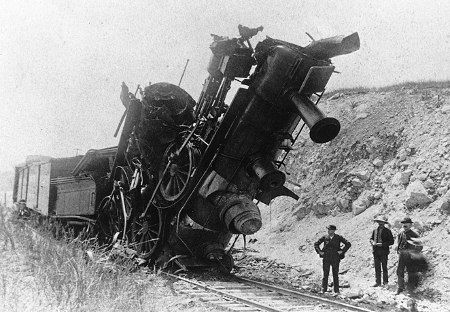
Collision_between_two_engines,_Bay_of_Quinte_Railway,_ON,_1892
Writer’s block and you. And some old-timey Canucks.

Oh, hey! I didn’t see you there. Come on in, and welcome to Write Full Circle’s first post, the kick-off for my new project dedicated to exploring the writing craft.

Embarking on a new journey is usually an energizing experience, but oftentimes it’s accompanied by a certain amount of anxiety, as well. Engaged couples get cold feet. Actors suffer from stagefright. And writers become afflicted with Blank Page Syndrome, a form of writer’s block that happens right when they sit down to start something new and suddenly freeze.

For me, it begins when I open up my word processor and get a good look at the white sea that is the canvas for whatever project I am set to tackle. A tightness in my gut works its way up my chest, through my arms, and down into my fingers, paralyzing them over the keyboard as the whitespace fails to fill up and the cursor continues to blink at me, slowly, almost mockingly.

Whether it’s due to a fear of failure, a lack of enthusiasm for a thing we’re obligated to write, or simply the daunting prospect of starting a new project from scratch, with absolutely no guarantee (or so we think) that it will turn out the way we want, Blank Page Syndrome continues to rear it’s ugly, prose-quashing head for me, and I bet it does for you, too. For Write Full Circle’s inaugural post, I want to share a few things to remember the next time you’re struggling with this problem.


If a goal does not exist, it is necessary to invent one

Dubious paraphrasing of Voltaire aside, let’s face it: Blank Page Syndrome is really just another form of procrastination. For a long time I resisted the idea of self-imposed deadlines or daily writing goals, even though it’s a recommended tactic for battling the urge to delay working on a task. Who wants to be pressured while doing something “for fun,” right?

Well, I’ll be the first to say that I was wrong.

In exchange for a bit of added pressure, the rewards of improved productivity and satisfaction with my work have been immense. The key is to start small, with deadlines or goals that are achievable in a short period of time, say 360 words in 1 hour (hello, blog-name reference!). If you’re writing fiction, you could start with a single short scene that you want to work on, and not stop until you’ve finished the first draft of that scene. Different methods work for different people, but if you’re dissatisfied with your productivity, making yourself stick to some type of goal can truly make a difference.


The only way to lose is not to play

The blank page only wins if you let fear stop you from writing the story you want (or need) to tell. Although I reserve the right to make exceptions to this rule, I believe that the only thing worse than a story told badly (or just a plain ol’ bad story) is a story that never gets told at all. Sure, when all is said and done, that book about a gawky, telekinesis-wielding teen may suck harder than a Hoover-brand black hole, but it might also end up being kinda successful.

In most cases, I’d rather something exist and turn out to be awful than remain stranded forever in the Land of the Lost (Ideas).


You can’t solve a jigsaw puzzle if it’s still in the box

When I first started writing, I tried to make sure that whatever story I wanted to tell would be a winner from word one, thinking I could save myself time with fewer rewrites. Guess how far I got with that plan?

Word three.

That’s an exaggeration, of course, but the fact is that writing is a lot like solving a jigsaw puzzle: there’s just no way to know how it fits together until all the pieces are out on the table and turned face-up.

This analogy occurred to me at some point after writing enough work for Adventure Gamers, where we have the freedom to organize the content of our articles in the way that seems best for a particular assignment (pending final approval from our editor-in-chief, of course). When I first started, I would often write and edit my work at the same time. While this approach isn’t too detrimental for short pieces, it’s not ideal, and for anything over a certain length there’s simply too many pieces to pull them out of the box a few at a time, expecting everything to fit together perfectly, one after the other.


Final thoughts

There’re few feelings as uncomfortable for a writer as being frozen, unable to bring their thoughts out onto the page. Remember, though, that most of us have been there at one time or another. It’s simply part of the writer’s journey, but so is learning to conquer it. Keeping these tips in mind the next time you find yourself staring at a blank screen may be just the help you need to banish Blank Page Syndrome the next time you start a new project.

Until next time,

Remember to Write Full Circle every day.


K R Parkinson Monogram
– K R Parkinson